Calm Focus: Stress Management for Remote Workers
A scenario-based e-learning course built in Articulate Storyline 360
Project Overview
Remote workers face a unique kind of stress — one that’s easy to overlook because home and work occupy the same space. Calm Focus follows Maya, a remote worker two years into her work-from-home life, through a week where stress starts winning. Learners make real choices alongside Maya and leave with a personalized set of strategies they’ve already practiced.
Audience: Burned-out remote workers navigating isolation, boundary blur, and screen fatigue. Designed for self-paced individual learning with no facilitator required.
Duration: Approximately 20 minutes
Tools and Skills
- Articulate Storyline 360 — course development, variable tracking, branching logic, drag-and-drop interaction, states and layers
- ElevenLabs — AI voiceover narration (voice: Hannah)
- Instructional design — scenario-based learning, learner persona development, consequence-driven branching
My Process
Designing for a real problem
Rather than building a topic-based course on stress management, I started with a learner persona — Maya — and built the entire course around decisions she would actually face in a real week. Every interaction asks the learner to respond to a realistic moment rather than answer a quiz question.
Making the branching meaningful
Section 2 lets learners explore three different stress techniques in any order, tracking which ones they tried without penalizing exploration. Section 3 presents a genuine boundary dilemma with three plausible responses — each leading to a different consequence — so learners experience the outcome of their choice rather than being told what’s correct.
Personalizing the payoff
Section 4 uses variable tracking built throughout the course to surface a personalized action plan reflecting the specific techniques each learner explored. No two learners see exactly the same closing slide — the course responds to their choices.
Technical problem-solving
Building the multi-technique tracking in Section 2 required a combination of True/False variables per technique and a counter variable with safeguard conditions to prevent double-counting on revisit. The drag-and-drop ritual builder in Section 3 required custom variable triggers layered on top of Storyline’s freeform interaction to track completion without using the built-in correct/incorrect system.
Course Structure
| Section | Title | Interaction Type |
|---|---|---|
| 1 | Recognizing Remote Stress | Click-to-reveal with variable tracking |
| 2 | In-the-Moment Techniques | Branching scenario with multi-path tracking |
| 3 | Boundary Rituals | Two-beat scenario + drag-and-drop builder |
| 4 | Your Action Plan | Personalized conditional text + commitment activity |
Screenshots
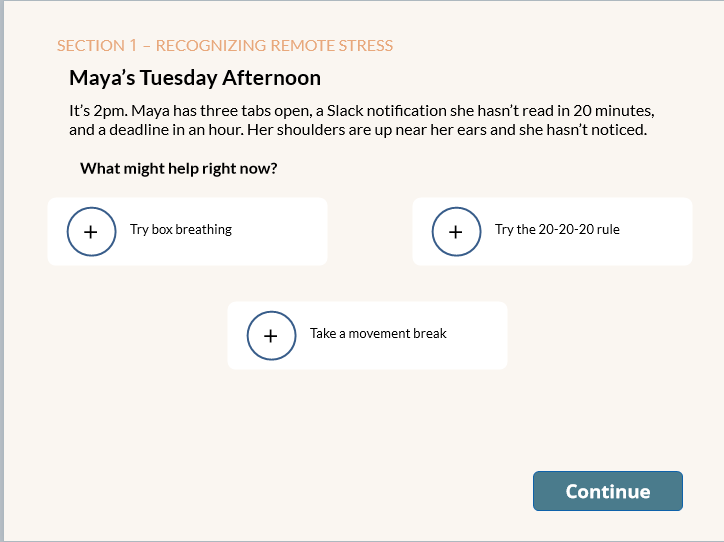 Section 1 — Click-to-reveal cards before interaction
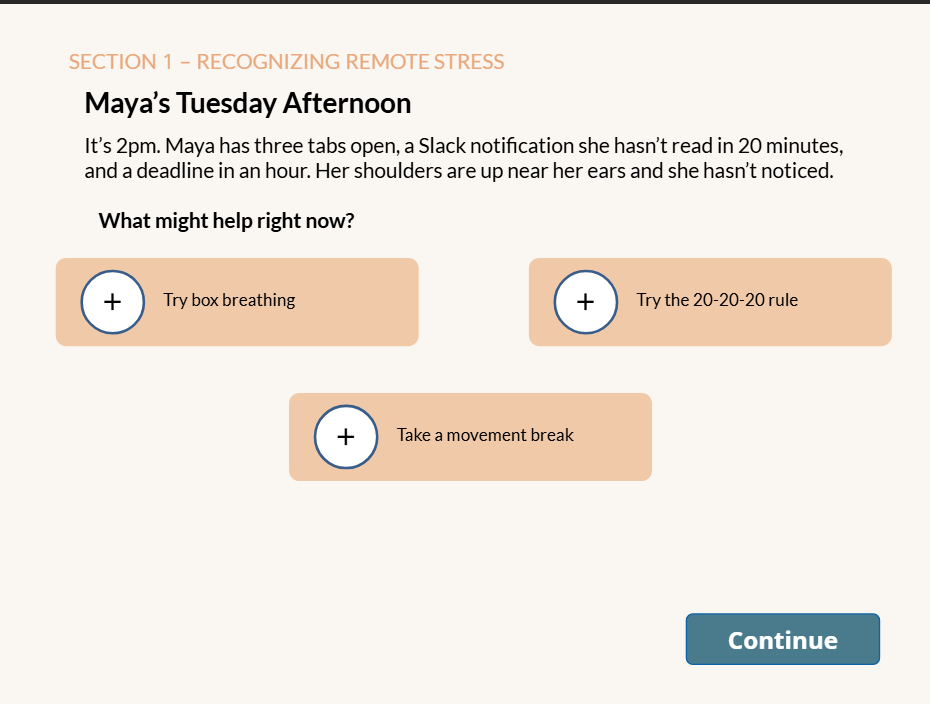 Section 1 — Visited state after exploring all three options
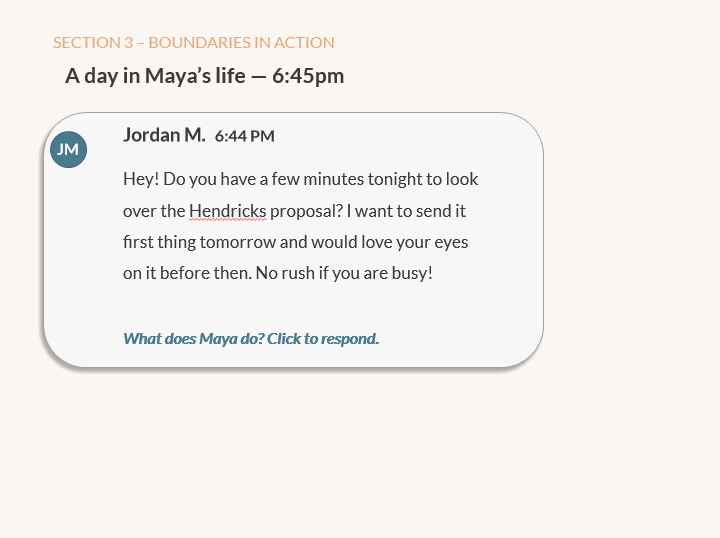 Section 3 — Boundary dilemma: after-hours Slack message
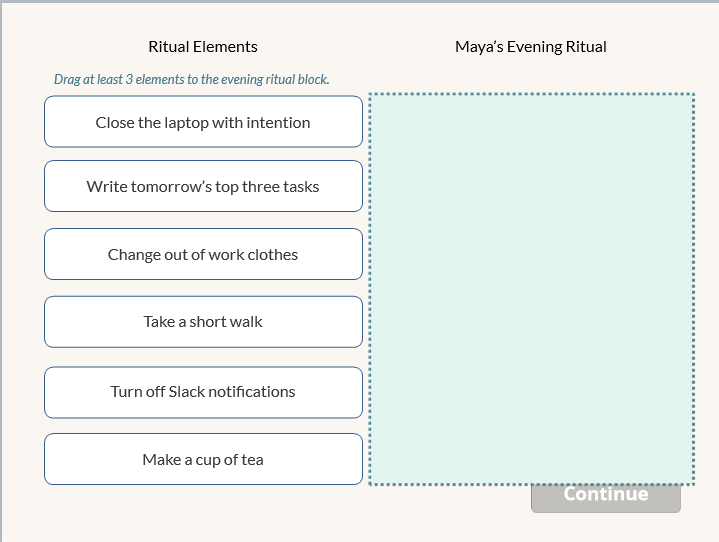 Section 3 — Learner builds their own evening ritual
What I’d Add With More Time
A pre-course stress assessment to personalize Maya’s starting scenario, and a manager-facing version of the course focused on recognizing stress signals in remote direct reports.
Supporting Documents
- Content Map (coming soon)
- Storyboard (coming soon)
- Job Aid (coming soon)
Built as a portfolio piece demonstrating instructional design and Articulate Storyline 360 development skills.